
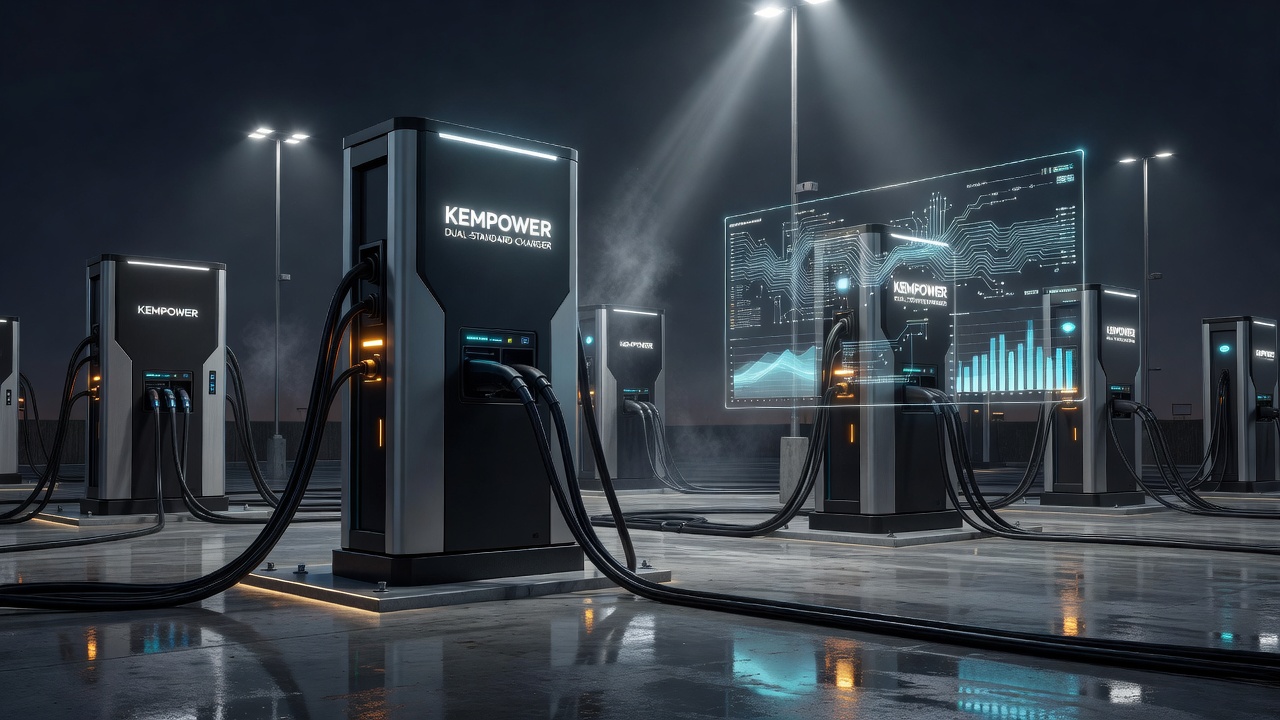
Kempower has introduced a charging unit that can serve a passenger car and a heavy-duty truck at the same site without forcing operators to build two separate systems. The new Mega Satellite Flex supports both the established Combined Charging System (CCS), delivering up to 560 kW, and the emerging Megawatt Charging System (MCS), capable of pushing up to 1.2 MW into a truck battery. It is Kempower's first dispenser to offer both standards from a single unit, a detail that signals how the charging industry is preparing for a period in which cars and freight vehicles will need to share infrastructure.
The timing reflects a real inflection point in electric mobility. CCS has been the dominant fast-charging standard for passenger EVs for years, but it was never designed for the power levels that electric trucks require to stay commercially viable. MCS was developed specifically to address that gap, allowing trucks to recharge in a timeframe closer to a diesel refueling stop rather than an overnight pause. Because the two standards are still coexisting, and will continue to do so for years, operators building new sites face a practical dilemma: invest in infrastructure for today's vehicles, tomorrow's vehicles, or both at once. Compatibility issues are not unique to hardware rollouts of this kind, either - drivers researching charging or connectivity troubleshooting sometimes end up on general guides like what to try when a VPN will not connect while trying to sort out unrelated software snags on the road, a small reminder that electric fleets now run on both power and data infrastructure.
One Site, Two Charging Standards
The core pitch behind the Mega Satellite Flex is site efficiency. Rather than dedicating separate real estate, power infrastructure, and permitting cycles to car charging and truck charging, an operator can install one unit that flexes between the two. The charger supports up to 1,500 amps on the MCS side and 700 amps for CCS, with cable lengths of 5 meters for CCS and 2.7 meters for MCS. That range accommodates the physical differences between a sedan's charging port and a truck's cab-mounted connector. An integrated payment terminal option means the unit can function as a self-service point without additional equipment layered on top.
There is also a forward-looking angle: the charger is built to take advantage of 800-volt vehicle architectures, an electrical platform increasingly common in newer EVs because it allows faster charging without proportionally higher current. As more vehicles, both passenger and commercial, adopt 800-volt systems, chargers that cannot exploit the higher voltage become a bottleneck. Kempower's design avoids that limitation from the outset.
Why Utilization Matters for Operators
Charging infrastructure is a capital-intensive business, and idle hardware is the enemy of return on investment. A dispenser that can only serve one category of vehicle sits unused whenever the "wrong" type of EV pulls in. By serving both cars and trucks, the Mega Satellite Flex is designed to keep utilization higher across more hours of the day, which matters enormously for site owners weighing the economics of high-power installations. Kempower has also built the unit to work with its existing distributed charging architecture, meaning operators already running Kempower systems can add the new charger without reengineering their power distribution or control systems.
A Signal for the Broader Market
The announcement came during Kempower's Unplug & Recharge event at ACT Expo, a venue focused on commercial transportation electrification, underscoring that the company sees freight and fleet charging as a central growth area alongside passenger vehicles. The Mega Satellite Flex is set to reach North America and Europe in July 2026, giving the market roughly a year to plan deployments around it. Whether other manufacturers follow with their own dual-standard units may determine how quickly mixed-use charging sites become the norm rather than the exception.