
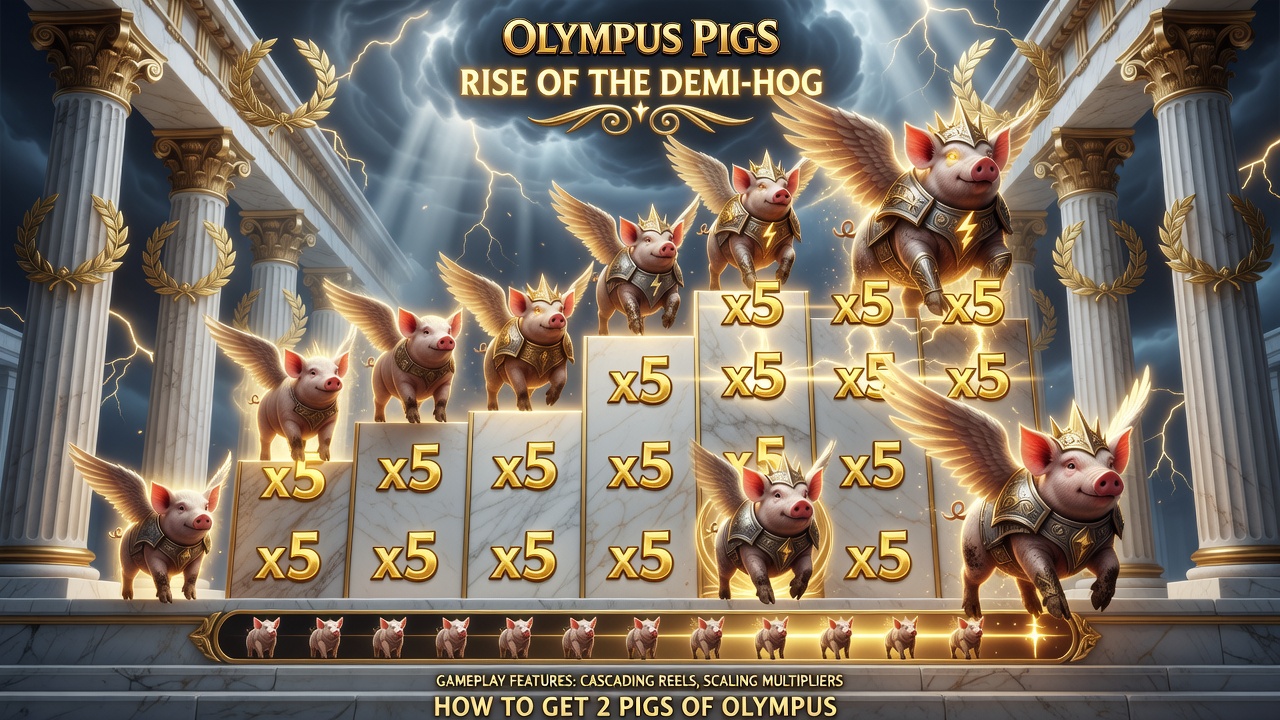
A hybrid creature that fuses divine bloodlines with barnyard stubbornness sounds like a punchline, yet it has become one of the more talked-about mechanics in recent slot design. The Olympus pigs concept takes a familiar mythological backdrop and pairs it with an unlikely mascot, then layers in a progression system that rewards patience over luck alone. That combination - myth, mutation, and mechanics - is why the title has held attention longer than most seasonal releases.
What makes the game worth examining isn't the novelty of pigs wearing laurel wreaths. It's the way the developer structured the reward path around a single evolving symbol. Players who want a full technical rundown before committing real money often start by reviewing 3 pigs of olympus 2 rise of the demi hog features, since the mechanics are dense enough that a quick glance at the paytable rarely tells the whole story. Once you understand how the demi-hog tier connects to the base game's volatility, the appeal becomes obvious - this isn't a cosmetic upgrade, it's a structural one.
This piece breaks down the gameplay architecture, explains what separates a demi-hog from a standard pig symbol, and walks through the practical steps for triggering the coveted 2 pigs of Olympus configuration. Anyone deciding whether to spend session time on this title should have a clear picture before spinning a single reel.
Understanding the Olympus Pigs Concept
The premise borrows structure from established mythology-themed slots but swaps out gods and titans for a barnyard twist. Instead of Zeus hurling lightning, players watch pigs ascend a hierarchy of divine favor. It's an odd pairing on paper, but the visual humor works because the underlying math model stays serious.
Origins of the Theme
Mythology slots have dominated the market for over a decade, and developers have been searching for ways to differentiate within a saturated genre. Grafting a comedic animal onto a serious pantheon setting gives the theme fresh visual identity without abandoning the mechanics players already trust - cascading wins, multiplier ladders, and bonus rounds tied to symbol density.
Why Pigs Specifically
Pigs carry cultural associations with luck, abundance, and greed in equal measure - a fitting symbol for a game built around escalating rewards. The choice also allows for exaggerated animation work: snorting, strutting, and eventually sprouting wings or armor as the creature evolves. That visual escalation mirrors the payout escalation, reinforcing the theme through motion rather than text alone.
Where the Series Fits in the Genre
Compared to static mythology slots where symbols never change appearance, this series stands out by making transformation a core mechanic rather than a bonus animation. The pig doesn't just pay out - it changes state, and that state carries forward information about how close the player is to a larger event.
Rise of the Demi-Hog: Gameplay Features
The subtitle isn't decorative. "Rise of the Demi-Hog" describes an actual in-game progression arc, and the rise of the demi hog gameplay features are what separate this entry from its predecessor. The core loop still revolves around spins and cascading symbols, but a secondary meter tracks pig evolution across the session.
The Evolution Meter
Every time a pig symbol lands and contributes to a win, it advances one stage toward demi-hog status. This isn't a fixed countdown - the rate of advancement depends on symbol frequency and reel position, which means aggressive betting doesn't automatically accelerate progress. Skill in reading the board matters more than raw stake size.
Cascading Reels and Chain Reactions
Wins don't simply pay and reset. Symbols clear and new ones drop in, occasionally triggering chain reactions that compound the evolution meter's growth. A single spin can, in rare cases, push a pig through two or three stages if the cascade sequence lines up favorably.
Multiplier Scaling Tied to Rank
As pigs rise in rank, their payout multiplier scales with them. A base-tier pig might contribute a modest multiplier, while a fully risen demi-hog can multiply a line win several times over. This scaling is the primary reason volatility increases sharply in the back half of extended sessions.
- Standard pig symbols pay baseline value with no multiplier attached
- Mid-tier evolved pigs add a fixed multiplier to any winning line they touch
- Fully evolved demi-hogs apply the highest multiplier tier and often unlock bonus triggers
Demi-Hog Details Every Player Should Know
The demi-hog isn't a single fixed sprite - it's a category with internal variation depending on how it was earned. Understanding these distinctions helps players judge how close they actually are to a maximum payout event rather than guessing from the reels alone.
Visual and Mechanical Markers
A demi-hog is visually distinct: armor plating, a golden aura, or wings depending on the version rolled. These aren't purely cosmetic - each visual marker corresponds to a specific multiplier tier baked into the game's payout table. Recognizing the marker mid-spin tells an experienced player the approximate value of the win before the total even displays.
Demi-Hog Features That Affect Bonus Rounds
Landing a demi-hog often satisfies part of the entry condition for the game's bonus round, sometimes independently of the scatter symbol requirement. This dual-path entry system is one of the more clever demi-hog features, since it gives players two distinct routes into the same high-value round rather than forcing reliance on a single symbol type.
Persistence Across Spins
Unlike many transformed symbols in competing titles, a demi-hog's rank doesn't reset after a single non-contributing spin. It persists until it either pays out in a winning combination or the session ends, giving players a reason to continue spinning even during a dry stretch - the invested progress isn't wasted.
How to Get 2 Pigs of Olympus
This is the configuration most experienced players chase, and it's also the most misunderstood mechanic in the entire title. Getting 2 pigs of Olympus on the board simultaneously - both at advanced evolution stages - triggers one of the highest fixed-multiplier events in the game.
Board Positioning Requirements
The two pig symbols don't need to be adjacent, but they do need to appear within the same active payline structure during the same spin cycle. This means wider grid configurations with more active lines statistically improve the odds of two evolved pigs landing in a scoring relationship.
Timing Your Bet Increases
Because the evolution meter builds over multiple spins regardless of stake, some players intentionally hold a lower bet during the build-up phase and increase it once one pig has already reached demi-hog status. This doesn't guarantee the second pig arrives, but it optimizes the cost-to-reward ratio during the higher-volatility final stretch.
Bonus Round Interaction
If the bonus round triggers while one pig is already evolved, the free-spin sequence frequently accelerates the second pig's progression due to increased symbol density during that mode. This is the most reliable - though not guaranteed - path toward the full 2 pigs of Olympus event.
Practical Tips for Maximizing Session Value
Mechanical understanding only helps if it translates into disciplined play. The following practical points come directly from how the evolution and multiplier systems interact across a typical session.
Bankroll Pacing
Given that evolution progress persists regardless of bet size, there's little reason to chase the demi-hog tier with oversized wagers early in a session. Pacing the bankroll to survive longer stretches increases the statistical opportunity for both the evolution meter and the bonus round to align.
Reading the Meter Instead of the Balance
Players fixated purely on their current balance often miss meaningful progress on the evolution meter, which is a better predictor of an imminent large payout than recent spin history. Treat the meter as the primary signal, not a secondary curiosity.
Session Length Considerations
Because rank persistence rewards longer play, shorter sessions structurally reduce the odds of reaching the demi-hog tier at all, let alone the 2 pigs of Olympus configuration. Players aiming specifically for that event should plan for extended, unhurried sessions rather than quick spins between other activities.
Frequently Asked Questions
Does bet size affect how fast a pig evolves toward demi-hog status?
No. Evolution speed is tied to symbol frequency and cascade activity, not stake size. Increasing your bet raises potential payout value but does not speed up the underlying progression meter.
Can a demi-hog's rank be lost mid-session?
Rank persists until the symbol contributes to a winning combination or the session ends. It does not degrade simply because a few spins pass without activity involving that symbol.
Is the bonus round the only way to trigger 2 pigs of Olympus?
No, but it's the most reliable path. The base game can theoretically produce the configuration on its own, though the increased symbol density during bonus spins makes it statistically more achievable there.
Are the visual markers on a demi-hog purely cosmetic?
They're not. Each visual variant corresponds to a specific multiplier tier reflected in the paytable, so recognizing the marker gives you an early read on the win's approximate value.
Why does the game emphasize longer sessions over quick spins?
Because evolution progress carries forward without resetting, longer sessions give the meter more opportunities to build naturally. Short, interrupted play sharply reduces the odds of ever reaching the highest-tier events.
What's the practical difference between this title and the original Olympus pigs release?
The original lacked the persistent evolution mechanic entirely - pigs paid a flat value with no rank progression. The addition of the demi-hog tier and its associated multiplier scaling is what defines this as a distinct sequel rather than a simple visual refresh.