
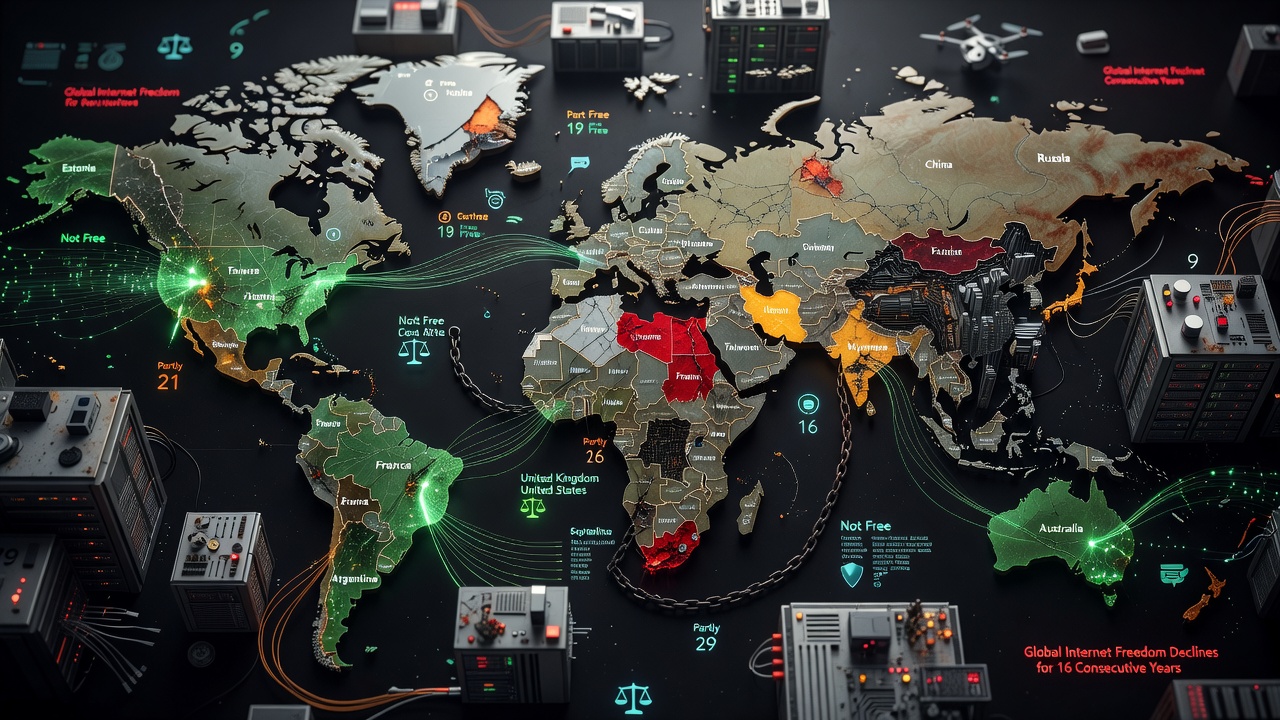
Belarus has again landed among the world's most restrictive digital environments, scoring just 21 out of 100 points in Freedom House's newly released Freedom on the Net 2026 report. Only five countries fared worse. The finding places Belarus firmly in the "not free" category, alongside a shrinking circle of nations where online expression carries real personal risk.
Where Belarus Stands
With a score unchanged from last year, Belarus trails only Cuba (19 points), Russia (16), and a bottom tier shared by China, Iran and Myanmar, each at 9 points. The stagnant score suggests neither meaningful reform nor further collapse - a frozen state of repression rather than a shifting one. By contrast, the report's top performers, including Estonia, Costa Rica, Taiwan, Australia, France, South Africa, the United Kingdom, the United States and Argentina, demonstrate that robust legal protections, judicial oversight and open civil society continue to correlate with freer digital spaces. Ukraine sits in the middle tier, classified as "partly free," a position that reflects both wartime constraints and the resilience of its independent online media.
Freedom House's methodology typically weighs obstacles to access, limits on content, and violations of user rights - factors such as website blocking, surveillance, arrests over online speech, and the technical ability of a government to throttle or sever connectivity entirely. A score like Belarus's usually reflects a combination of all three: restricted infrastructure, heavy content filtering, and legal frameworks that criminalise dissent expressed online.
A Shrinking Dataset, A Longer Decline
This year's report covers only 38 countries, after Freedom House suspended assessments in 34 others - nearly halving its usual scope. That contraction matters. It likely reflects resource constraints facing independent monitoring organisations, but it also means the global picture painted by the report is now less complete, leaving gaps precisely where internet conditions may be deteriorating fastest and least visible.
Despite the narrower lens, the report's core conclusion remains consistent with previous editions: global internet freedom has declined for sixteen consecutive years. That is not a sudden shock but a slow, structural erosion - one driven by authoritarian governments refining their tools of control rather than inventing new ones from scratch.
Isolation, Age Limits and the AI Question
Two trends stand out this year. First, authoritarian states are intensifying efforts to wall off their populations from the global internet, building domestic alternatives to international platforms and infrastructure that can be more easily monitored or shut down. Second, age-verification rules for social media users are spreading, ostensibly to protect minors, but carrying implications for anonymity and data collection that extend to all users.
Artificial intelligence has emerged as a new fault line. Governments are drafting rules against AI-enabled impersonation and harassment - a legitimate response to real harms. But Freedom House warns that some officials are using these same legal tools to suppress legitimate speech, blurring the line between protection and censorship. The report singles out agentic AI - systems capable of acting independently rather than simply generating text or images - as a force poised to reshape the internet's basic architecture, urging that any new rules preserve open exchange rather than entrench new forms of control.
Why It Matters Beyond Belarus
For ordinary users in restrictive environments, tools like encrypted messaging and VPN connections remain among the few practical defenses against surveillance and blocking, though their effectiveness depends heavily on local law and enforcement capacity. The report's broader warning is that the infrastructure of control - deep packet inspection, mandatory data localisation, platform bans - is maturing everywhere, not just in the lowest-scoring states. That makes the fight over internet freedom less a story about a handful of outliers and more a test of whether open societies can hold the line as authoritarian techniques spread.