
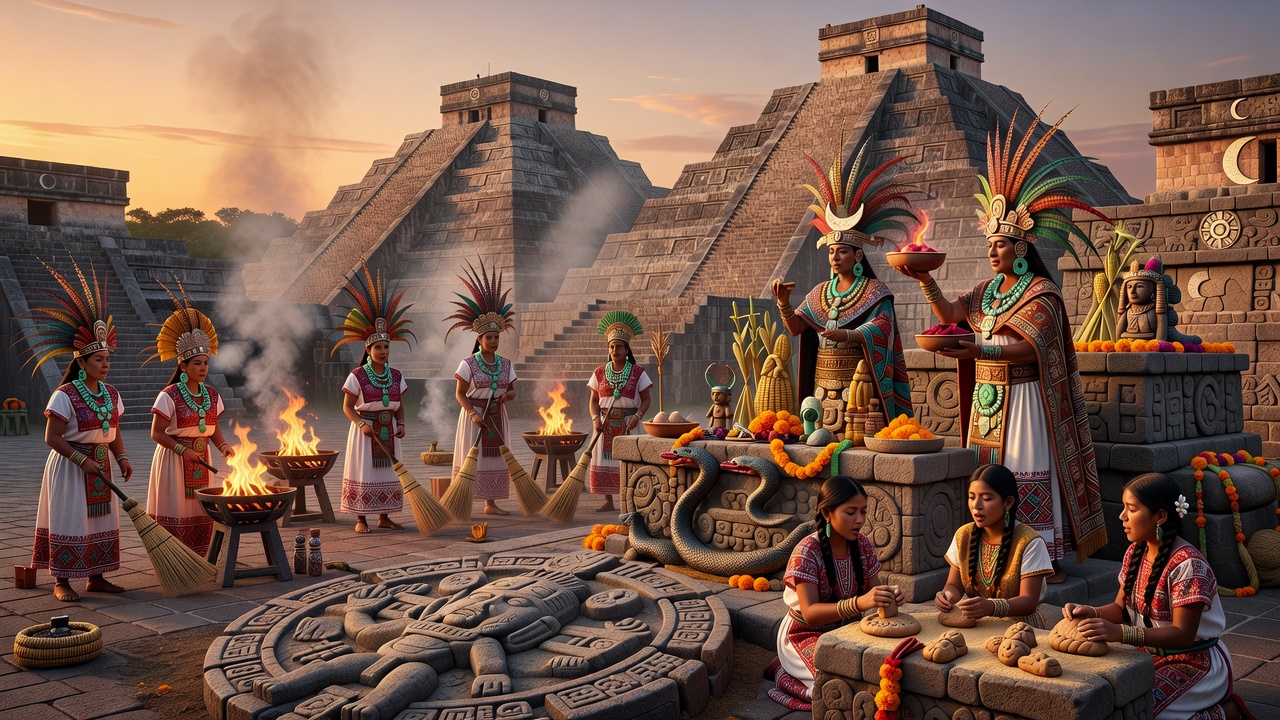
Spanish chroniclers who witnessed the Aztec capital of Tenochtitlan in the early sixteenth century wrote of women who lived within temple walls, tended sacred fires, and performed rites tied directly to the empire's survival. These women were not peripheral figures. An Aztec priestess held authority that shaped agricultural cycles, marriage customs, and the political legitimacy of rulers. Yet most popular accounts of Aztec religion focus almost entirely on male priests and human sacrifice, leaving the female half of the ritual system in shadow.
The gap matters because Aztec religious rituals cannot be fully understood without the women who organized them. Priestesses managed goddess cults, trained young women in temple schools, and performed ceremonies that male priests were forbidden to conduct. For readers who enjoy exploring this history through modern entertainment, some slot games now draw on these very themes - titles built around aztec priestess features have introduced a new audience to the imagery of temple ritual, even if the historical reality was far more complex than any game reel. This article separates that entertainment layer from the documented past.
What follows draws on colonial-era codices, archaeological findings at Templo Mayor, and the broader framework of Aztec mythology and goddess worship to reconstruct who these women were, what they did, and why their work mattered to an empire that measured its survival in ritual precision.
Who Were the Aztec Priestesses?
The term "priestess" covers a range of roles within Aztec society, from young girls serving temporary temple service to senior women who directed entire religious complexes. Unlike a simple ceremonial title, the position carried administrative weight, moral authority, and specialized knowledge passed down through structured training.
Social Origins and Training
Girls entered temple service, known as the calmecac or the telpochcalli depending on class and calling, often around age twelve or thirteen. Noble families frequently dedicated daughters to religious life as a mark of prestige, though commoner girls could also enter service, particularly if their families had made a vow tied to a goddess. Training included memorization of ritual songs, herbal knowledge, weaving for temple textiles, and the strict behavioral codes expected of anyone serving the gods.
Ranks Within the Temple Hierarchy
Not every priestess held equal status. Some served for a fixed period before returning to ordinary life and marriage, while others committed permanently and rose through internal ranks. The highest-ranking women, sometimes called cihuatlamacazque, oversaw junior priestesses, managed temple provisions, and represented their goddess cult in public ceremonies attended by nobility.
Daily Duties Inside the Temple
Daily life centered on fire-keeping, incense burning, and the preparation of ritual foods and drinks used in offerings. Priestesses also maintained the physical temple space, which required constant attention given the perishable nature of textiles, feathers, and floral offerings used in Aztec ceremony.
- Sweeping and purifying temple grounds before dawn rituals
- Preparing sacred maize dough figures representing specific deities
- Leading younger initiates in call-and-response hymns
- Overseeing textile production dedicated to goddess statues
The Role of Priestesses in Aztec Religious Rituals
Aztec religious rituals followed a fixed calendar of eighteen twenty-day months, each dedicated to specific deities and demanding specific ceremonial acts. Priestesses were essential to this calendar, particularly for rituals tied to fertility, harvest, and female deities where male priests had no ceremonial standing.
Fertility and Harvest Ceremonies
Rituals honoring maize and earth goddesses required women to lead processions, prepare ceremonial foods, and in some documented cases, embody the goddess herself through ritual impersonation. The month of Ochpaniztli, associated with the harvest and with the goddess Toci, involved priestesses performing sweeping rites meant to cleanse the community symbolically before the agricultural cycle turned.
Rituals Exclusive to Female Practitioners
Certain ceremonies simply could not be performed by men. Rites tied to childbirth, female puberty, and the protection of women in labor fell entirely within priestess jurisdiction. This division reflected a broader Aztec worldview in which cosmic balance depended on paired male and female forces, mirrored precisely in temple staffing.
Music, Dance, and Offerings
Ceremonial performance was inseparable from religious function in Aztec practice. Priestesses composed and performed hymns, directed dance troupes during festival days, and managed the preparation of blood, copal incense, and food offerings presented at altars throughout the ritual year.
Templo Mayor: The Sacred Center of Priestly Life
No discussion of Aztec religious structure can bypass Templo Mayor, the twin-pyramid complex at the heart of Tenochtitlan dedicated to Huitzilopochtli and Tlaloc. Archaeological excavation since the late 1970s has revealed the physical scale of the ritual life priestesses helped sustain.
Architecture and Layout
The temple complex rose in stages, with each ruler adding new construction layers over previous ones. Surrounding the main pyramid stood smaller shrines dedicated to other deities, including goddesses such as Coyolxauhqui, whose dismembered stone image was uncovered at the pyramid's base and remains one of the most studied artifacts from the site.
Excavation Discoveries Tied to Female Worship
Offerings recovered from Templo Mayor include figurines, jade ornaments, and ceramic vessels associated with goddess veneration, many likely placed by priestesses during dedicated ceremonies. These findings give physical confirmation to written accounts describing women's ritual labor at the site.
Templo Mayor as an Administrative and Ritual Hub
Beyond ceremony, the complex functioned as a training ground and residence for religious personnel, including priestesses assigned to specific shrines. The physical proximity of living quarters to worship spaces meant temple life was continuous, not confined to festival days alone.
Aztec Mythology and Goddess Worship
Priestesses drew their authority directly from the goddesses they served, and Aztec mythology offers a rich, sometimes contradictory portrait of female divine power spanning creation, war, fertility, and death.
Major Goddesses and Their Domains
Coatlicue, mother of Huitzilopochtli, embodied both creation and destruction in a single terrifying form. Xochiquetzal governed love, beauty, and craftsmanship. Tlazolteotl absorbed sin and granted purification. Each goddess required distinct ritual approaches, and priestesses often specialized in serving one deity across an entire career.
Goddess Impersonation Rituals
In certain festivals, a priestess or chosen woman ritually became the goddess through costume, behavior, and symbolic action, sometimes for the duration of a single ceremony and in rarer, more severe cases, culminating in sacrifice believed to sustain cosmic order. These acts reveal how thoroughly Aztec religion merged human performers with divine identity.
Mythology as Justification for Priestly Authority
Myths were not mere stories; they functioned as legal and religious precedent. A priestess invoking Coatlicue's origin myth during a fertility rite was reinforcing her institutional authority through narrative, giving her actions cosmic legitimacy that ordinary social status could not provide.
Ancient Mesoamerican Priestess Traditions Beyond the Aztec
The Aztec priestess did not emerge in isolation. Female religious authority appears across Mesoamerican civilizations, suggesting a shared cultural logic regarding gender and sacred duty that predates the Aztec state by centuries.
Maya and Zapotec Parallels
Maya inscriptions and iconography depict women performing bloodletting rituals and serving as intermediaries with ancestral spirits, roles structurally similar to Aztec temple service. Zapotec religious sites also show evidence of female ritual specialists tied to fertility and ancestor worship, indicating regional continuity in how Mesoamerican societies structured religious labor by gender.
Shared Symbolism Across Cultures
Serpent imagery, maize deities, and lunar goddesses recur throughout Mesoamerican religious systems, each culture adapting shared symbols to local political needs. This overlap helps explain why Aztec priestesses inherited a ready-made symbolic vocabulary rather than inventing one from nothing.
Why Comparative Study Matters
Placing the Aztec priestess within this broader Mesoamerican context corrects the tendency to treat Aztec religion as an isolated phenomenon. It was, instead, the culmination of centuries of regional religious development, refined and centralized under imperial administration.
Decline and Legacy of the Priestess Tradition
Spanish conquest in 1521 dismantled the formal temple system almost immediately, but the memory and partial practice of priestess traditions did not vanish overnight.
Suppression Under Colonial Rule
Missionaries specifically targeted temple institutions, viewing priestesses as obstacles to conversion given their public authority and ritual knowledge. Many practices were driven underground, merged quietly with Catholic saint veneration, or lost entirely within a generation or two.
Survival in Folk Practice and Memory
Elements of goddess veneration persisted in altered form through syncretic folk Catholicism in parts of Mexico, where devotion to certain female saints echoes, however faintly, older patterns of goddess worship once overseen by trained priestesses.
Modern Scholarship and Public Interest
Archaeological work at Templo Mayor since the twentieth century, alongside careful re-reading of colonial codices, has restored much of what was nearly erased. Growing public curiosity about ancient Mesoamerican priestess roles reflects a broader shift toward recognizing women's historical agency in civilizations long portrayed through a male-centered lens.
Frequently Asked Questions
Did Aztec priestesses ever perform human sacrifice themselves?
Documented sources indicate that the act of sacrifice itself was almost always carried out by male priests, though priestesses played essential roles in preparing offerings, leading processions, and in certain goddess-impersonation rites where women were the ritual focus rather than the executors.
Could a priestess leave temple service and marry?
Yes, many women served for a defined period, often tied to a vow made before entering, and returned to ordinary domestic and marital life afterward. Permanent commitment existed but was not universal, unlike some misconceptions suggest.
What happened to priestesses after the Spanish conquest?
Temple institutions were dismantled rapidly, and formal priestess roles ended within a few decades as missionaries suppressed indigenous religious practice, though fragments of ritual knowledge survived informally within families and communities for generations.
How do we know about priestess duties if so much was destroyed?
Colonial-era codices written by indigenous informants working with Spanish friars, combined with archaeological evidence from sites like Templo Mayor, provide the primary basis for reconstructing these roles with reasonable historical confidence.
Were all Aztec goddesses served exclusively by women?
No, male priests handled administrative and sacrificial duties even within female deity cults, but ritual acts requiring direct embodiment of the goddess or ceremonies tied to childbirth and female fertility were reserved specifically for priestesses.
Is Templo Mayor still being excavated today?
Excavation and analysis continue, with ongoing work uncovering additional offering caches and structural details that refine scholarly understanding of both male and female religious roles within the complex.